

Since the invention of fiberopitcflexible endoscope by Dr. Hirschowitz and his colleagues Larry Curtis and C. Wilbur Peters in 1957, it has been dominating the market for almost 70 years. The massive installation has even made some end users equal the fiber optic endoscope to the flexible endoscope, which is wrong especially after the non-fiber LED chip-on-tip technology is available on market.
The article, from the perspective of flexible endoscope manufacturer, aims to explain the pros and cons of flexible endoscope in terms of fiber optic structure and non-fiber structure.
You may have heard the conception of video endoscope and fiber endoscope, but do you know that a video endoscope can be, actually most likely, a fiber optic endoscope? Here is a simple drawing to show the flexible endoscopes of different structures.
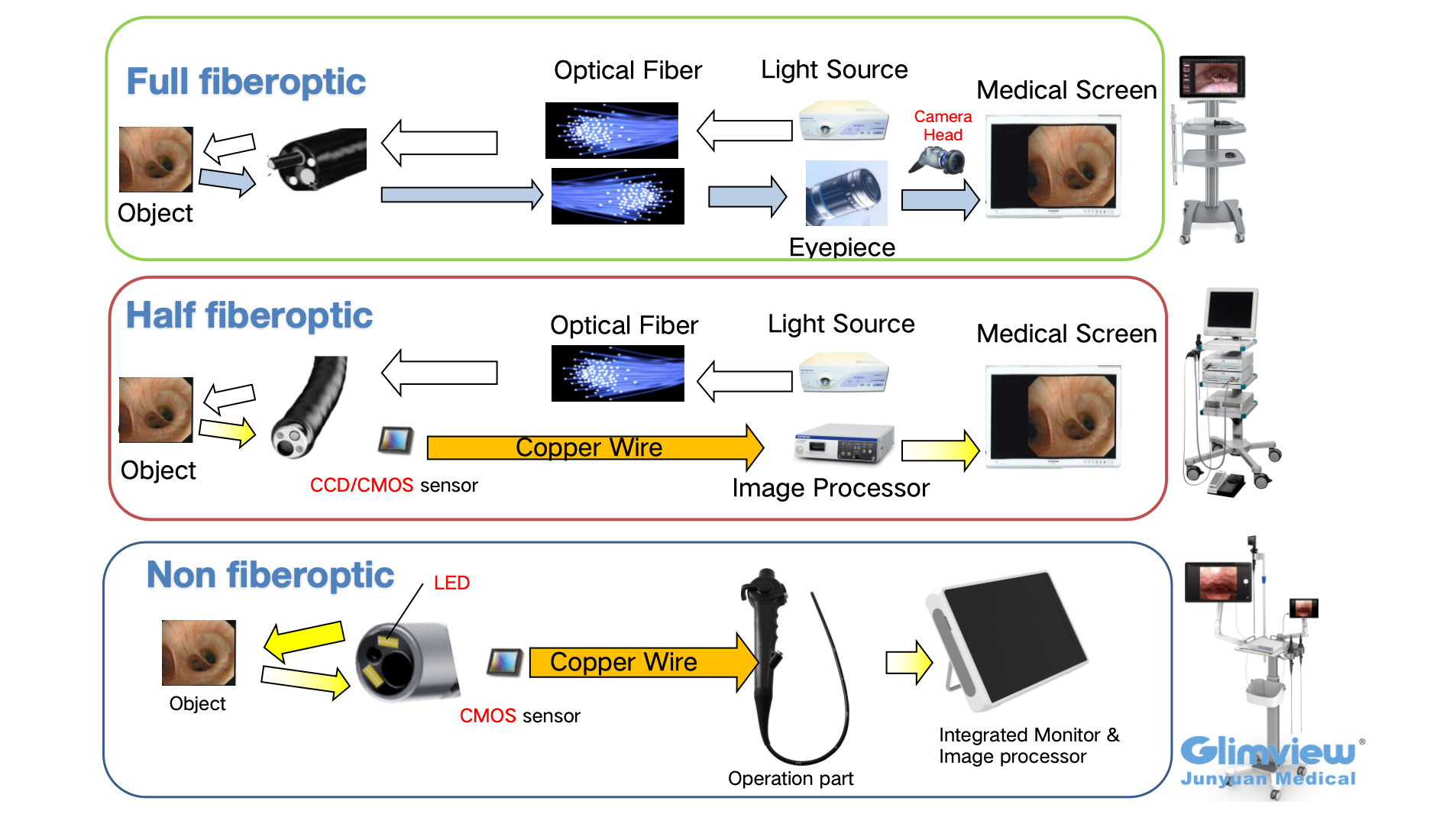
The structure difference between fiberoptic and digital endoscopes.
The first and the second systems are both fiberoptic endoscopes but the half fiberoptic is also a video endoscope, because it adopts the CCD or CMOS sensor for image capture, displaying a digital image after processing. Therefore, both the half fiberoptic and the non fiberoptic systems are video flexible endoscopes.
Questions: What is the difference of the two types video flexible endoscopes?
The half fiberoptic system usually come as a tower system, which includes a bunch of optical fiber for illumination, and an independent electrical circuit for imaging. The electrical circuit combines a camera sensor (CCD or CMOS), an image processor and an external medical screen to display the image or, in some advanced models, to enhance the image. Therefore, the end user has to buy a full system including a light box, an image processor, an external medical monitor, and a cart to work together with the flexible endoscope. Except for the flexible endoscope, the rest of the equipment are supposed to work for many years unless the manufacturer stops production of the specific flexible endoscopes.
The non-fiberoptic flexible video endoscopes, on the contrary, come as a super simplified system with only an image processor (or sometimes no need in terms of USB type endoscope, such as the Smart System of Glimview® Flexible Video Nasopharyngoscope, M3E) and a trolley (if required) with the flexible endoscope. Since the LED lights on the front tip will serve as the light source, the optical fiber is eliminated and there’s no need to buy a light box. The image processor is also integrated with a screen (3.5”, 10.1”, 12.1”, or 15.6”), so there’s also no need to buy an external medical monitor.

An example of Non-fiberoptic flexible video endoscope: Glimview® Video Flexiblescopes, M3S
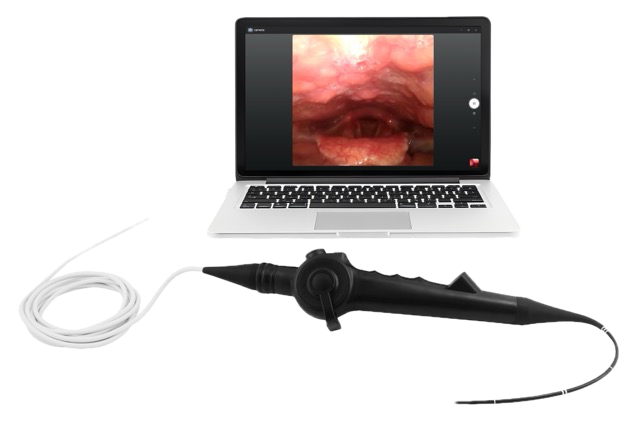
An example of USB Type Non-fiberoptic flexible video endoscope: Glimview® Flexible Video Nasopharyngoscope, M3E
Question: Which flexible endoscope system should I choose for my practice?
The full fiberoptic flexible endoscopes have been popular for many years due to its low cost. Hence, customer with limited budget will usually choose the full fiberoptic ones but its small viewing area, fragile nature, and a lack of video/photo function have been a headache to many users.
The half fiberoptic system seems very attractive but most probably only the tertiary hospital can afford.
Therefore, the uprising of non-fiber flexible video endoscope provides a third option to both the small clinics and the large ones.
Here is a short summary of pros and cons between the 3 types of flexible endoscope systems.

Due to the fragile nature of optical fiber and the must of bending function of flexible endoscope, systems with fiberoptic are not as durable as the non-fiberoptic system. However, the image enhancement function and the higher brightness make the half fiberoptic tower system better than the non-fiberoptic system. The LED chip-on-tip system has a brightness limit due to the limited space and the requirement of temperature safety of the front tip. However, if the LED technology could upgrade in terms of mini LED, brightness limit issue of non-fiberoptic system could also be solved in the future.
All above, for private practice, non-fiberoptic video system is an affordable choice with good portability, video function and high durability. For customer with good budget or the demand of advanced imaging function, the half-fiberoptic video system could be the only choice. However, for ultra-thin flexible endoscope demand (say less than 2.0mm), the full fiberoptic system is still the most cost-effective choice for its brightness advantage against the non-fiberoptic system.